8oz Ice Cream Cup 7 Buying Tips for Global Buyers

Time:2026-09-26 Author:Mason
0%

An 8oz Ice Cream Cup may look like a small purchasing decision. At scale, it affects product presentation, packing speed, shipping costs, and customer experience. A lid that loosens in transit or a cup that stacks poorly can create avoidable problems. Small details matter.

The International Dairy Foods Association (IDFA) reports that the United States produces more than one billion gallons of ice cream annually. That scale highlights why consistent packaging matters to manufacturers and distributors. For global buyers, the right cup depends on more than nominal capacity: check usable fill volume, rim and lid fit, freezer performance, print quality, and carton dimensions. Test samples with the actual product, including after storage and handling. A catalogue image cannot show everything.

Material choices also deserve careful review. The OECD’s Global Plastics Outlook reports that packaging represented 40% of global plastic waste in 2019. This is a useful industry benchmark, not a complete measure of any single cup’s impact. Compare material specifications, supplier documentation, and locally relevant disposal options before making environmental claims. No checklist removes every risk; assumptions about recyclability and performance need a second look. These seven buying tips will help global buyers assess quality, customization, supplier reliability, cost, and logistics before placing an order.
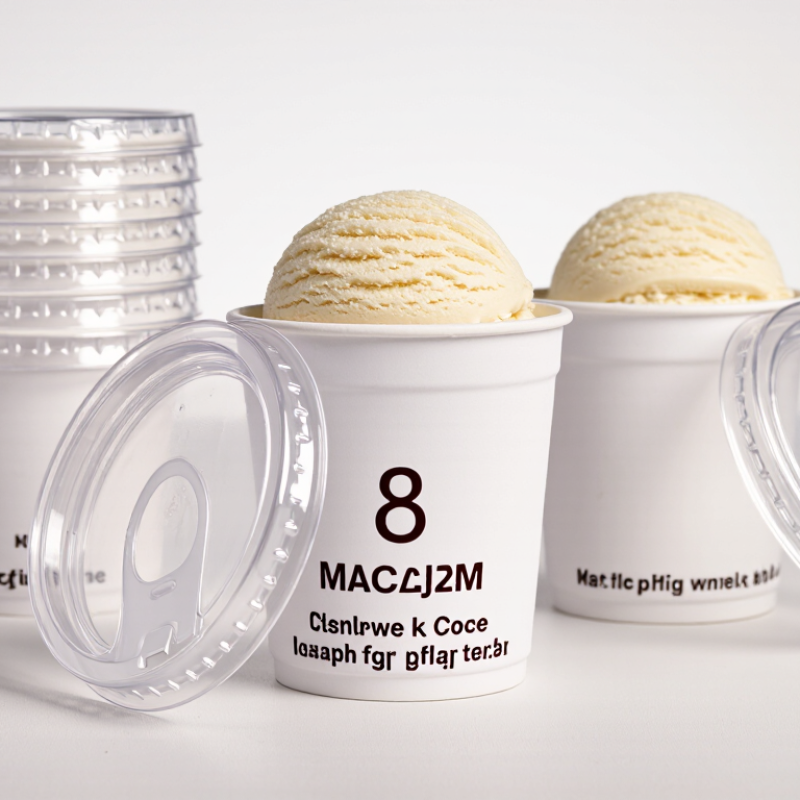
8oz Ice Cream Cup 7 Buying Tips for Global Buyers

Set the Serving Specification: 8 US fl oz Equals 236.6 mL

An 8 US fl oz ice cream cup holds about 236.6 mL by volume. That is not the same as eight ounces by weight. Ice cream weight changes with density and air content, so a filled cup may weigh more or less than expected. Keep the distinction clear when comparing supplier specifications.

Check how the stated capacity is measured. A cup filled to the rim can hold 236.6 mL, but that leaves little room for a lid or a steady walk to the table. For a realistic serving, test the cup with your actual scoop and leave enough headspace. A small gap matters. Sauces and toppings also take up room.

Ask for a sample and measure it with water using a graduated container. Then fill it with the intended ice cream, fit the lid, and check for smearing or pressure on the surface. Shapes vary; two cups marked 8 oz may not feel equally roomy. I once assumed the numbers told the whole story. They did not. Record the fill level, lid fit, and serving weight before confirming an order, and repeat the check if the recipe changes.

8 oz Ice Cream Cup: Serving Volume Conversion

Use US fluid ounces to specify cup capacity consistently. One US fl oz equals approximately 29.5735 mL, so an 8 fl oz serving is approximately 236.6 mL.

Compare Paper, PP, and PET Cups for Insulation and Leak Resistance

For global buyers, an 8oz ice cream cup must resist melting, condensation, and transport pressure. Material choice controls all three. Paper cups usually provide better perceived insulation because the fiber wall slows heat transfer. However, paper needs a reliable inner coating and strong rim construction. The 2024 Smithers packaging report identifies barrier performance as a major requirement for paper foodservice packaging. A weak coating can soften after several minutes.

PP cups tolerate moisture well and remain flexible in freezers. Their leak resistance is generally dependable, especially with a correctly fitted lid. Yet, thin PP walls may feel cold quickly in the hand. PET cups offer excellent clarity and strong dimensional stability. They also resist leaks effectively, but their rigid walls can transfer cold faster than insulated paper designs. Clear visibility helps product presentation. It does not guarantee better insulation.

Ask suppliers for wall thickness, coating type, lid compatibility, and freezer-temperature test results. Request testing under realistic conditions: frozen storage, five-minute handling, and liquid movement during delivery. ASTM F2096 can support package leak testing, although it may not reproduce every ice cream condition. A 2023 Foodservice Packaging Institute report highlights the need to balance performance, material use, and end-of-life management. I would not trust a cup based only on appearance. Small production differences matter. Test samples from more than one batch. Condensation still surprises buyers.

8oz Ice Cream Cup: 7 Buying Tips for Global Buyers — Compare Paper, PP, and PET Cups for Insulation and Leak Resistance

Buying Tip Paper Cups PP Cups PET Cups What Buyers Should Check
1. Compare insulation and serving comfort Paper walls can feel less cold to the touch than thin plastic walls. Insulation varies with cup-wall thickness and construction. Thin PP walls offer limited insulation; a thicker wall or separate sleeve may improve handling comfort. Thin PET walls offer limited insulation and may feel cold when held with frozen contents. Request filled-cup handling tests at the intended serving temperature. Do not assume material alone determines insulation.
2. Check leak resistance Leak performance depends on the inner barrier coating, side seam, and bottom seal. Uncoated paper is not suitable for prolonged contact with wet contents. A well-formed PP cup can be liquid-tight, but defects or a poorly matched lid can still cause leaks. A well-formed PET cup can be liquid-tight; inspect the rim and lid fit as well as the cup body. Test filled cups upright and during realistic handling. Confirm leak performance for the complete cup-and-lid combination.
3. Verify the 8 oz capacity Capacity and dimensions vary by design; paper cups may have different rim diameters and profiles despite the same nominal volume. PP cup dimensions and fill capacity vary by mold and supplier. PET cup dimensions and fill capacity vary by design; clear walls can make fill levels easy to see. Confirm whether 8 oz means brimful capacity or the intended serving fill. Request a dimensioned drawing and sample.
4. Match the lid and rim Paper rims are commonly designed for compatible snap-on or press-on lids; fit is not universal. PP cups may use compatible plastic lids, but rim profiles differ among designs. PET cups may use compatible plastic lids, but a matching rim profile is essential for a secure fit. Specify the exact lid, rim diameter, and closure style. Test opening, carrying, and stacking with the selected lid.
5. Consider visibility and presentation Usually opaque, so the product is not visible through the cup. Printing can support product identification and decoration. Available in different colors and levels of translucency; appearance depends on the design and resin. Often chosen when a clear view of the product is important; clarity depends on the specific cup design. Review production samples for color, transparency, print quality, and appearance under refrigerated display lighting.
6. Check cold-use performance Confirm that the cup and its lining are suitable for frozen products and condensation during the intended service period. PP is commonly used for food containers, but performance depends on cup design and the specified temperature range. PET is commonly used for food packaging; confirm the supplier’s stated suitability for the intended cold-use conditions. Ask for the product’s temperature-use information and test samples through the actual storage, filling, and serving process.
7. Verify food-contact and end-of-life requirements Ask what the cup’s barrier lining is made from. Paper cups with plastic or other barriers may require specialized collection or processing. PP recycling availability depends on local collection and sorting systems; acceptance varies by market. PET recycling availability depends on local collection and sorting systems; cup format, color, and attached components can affect acceptance. Request applicable food-contact documentation for the destination market. Check local recycling guidance rather than relying on resin type alone.

Performance varies by cup construction, coating, wall thickness, lid fit, and local handling conditions. Confirm specifications and test production samples before placing a bulk order.

Check Food-Contact Materials Against FDA 21 CFR Parts 174–178

For an 8oz ice cream cup, food-contact compliance depends on the complete construction, not just the visible paperboard. A cup may combine paper, a polymer lining, printing inks, and adhesive seams. Small details matter. FDA 21 CFR Parts 174–178 address different indirect food-additive uses. These include coatings, paper components, polymers, and processing aids. The relevant provision depends on each material and its intended conditions of use.

Ask suppliers for a food-contact compliance statement tied to the exact cup specification. It should identify materials and applicable CFR provisions, plus any limits on temperature, contact time, or food type. Ice cream is cold, but filling, storage, and serving conditions can differ. Check whether the evidence covers the finished cup, not only a resin or paper grade. That gap is easy to miss.

Review supporting declarations, specifications, and change-control practices before ordering at scale. Verify that inks and adhesives stay outside food-contact areas, where relevant, and ask how production changes are controlled. A test report can help, but it does not automatically establish compliance for every formulation or use. Compare the cup’s documented conditions with your actual filling line. Paperwork can be incomplete; request clarification rather than guessing.

Verify Compostability Claims Against ASTM D6400 or EN 13432

8oz Ice Cream Cup: 7 Buying Tips for Global Buyers

Compostability claims need evidence, not attractive wording. ASTM D6400 evaluates plastic items designed for industrial composting in the United States. EN 13432 covers packaging requirements in European composting systems. They are not interchangeable labels. Ask suppliers for valid test reports, certification scope, and product references. Check whether the documents cover the complete cup, not only its resin.

Tip: Inspect the rim, coating, printing ink, adhesive, and lid separately. A certified-looking cup may still contain non-compostable accessories. Request samples from the actual production line. Compare the sample with the submitted documents. Small changes can affect results. This is often missed.

Tip: Confirm the testing laboratory, report date, sample description, and standard edition. Do not accept a generic “biodegradable” statement. Ask where the cup is intended to break down. Industrial composting usually requires controlled heat, moisture, oxygen, and processing time. It may not decompose in a backyard bin. Be precise with customers.

Tip: Review migration, food-contact, and temperature data alongside compostability records. Ice cream creates cold, wet conditions, while transport may involve stacking and condensation. Test filled cups for leakage, cracking, label adhesion, and freezer performance. One weakness remains: documents may not reflect every color or size. Recheck before a large order.

Confirm Lid Fit, Case Pack, MOQ, and Landed Cost Before Ordering

Buying an 8oz ice cream cup requires more than checking volume and price. Confirm the lid fit with filled samples, not empty cups. A loose lid can cause leaks during stacking and refrigerated transport. Check rim diameter, sealing force, condensation resistance, and whether the lid stays secure after repeated opening. Test it cold.

Case pack affects warehouse space and freight efficiency. Ask for units per carton, carton dimensions, gross weight, and pallet pattern. Smithers’ The Future of Global Packaging to 2028 estimates the packaging market will exceed 1.2 trillion dollars by 2028, increasing pressure to reduce material and logistics waste. A smaller case may lower handling damage, but it can raise freight cost per cup. There is no universal best pack.

MOQ needs a landed-cost calculation. Include cup price, lid price, tooling, inland delivery, ocean or air freight, duties, insurance, inspection, and destination charges. PMMI’s 2024 packaging industry reporting highlights continuing cost and supply-chain pressure across packaging operations. Request a written quotation with Incoterms and production lead time. Then compare cost per usable set, not cost per cup. Do not guess. I once saw a low unit price lose its advantage after port charges and oversized cartons were included. Recheck currency, exchange-rate assumptions, and damaged-unit allowances before ordering.

FAQS

Why should buyers verify compostability claims for an 8oz ice cream cup?

Attractive wording is not evidence. Request valid test reports, certification scope, and references for the complete cup.

Are compostability standards interchangeable across markets?

No. Different standards support different composting systems. Confirm the required standard for the destination market.

Which cup parts need separate inspection?

Inspect the rim, coating, ink, adhesive, and lid separately. Small material changes can affect composting results.

What should buyers check in a compostability report?

Check the laboratory, report date, sample description, standard edition, and tested product scope. Generic claims are insufficient.

Will a compostable cup break down in a backyard compost bin?

Not necessarily. Industrial composting usually needs controlled heat, moisture, oxygen, and processing time.

How should buyers test an ice cream cup before ordering?

Use filled samples from actual production. Check leakage, cracking, label adhesion, freezer performance, and condensation resistance.

How can buyers confirm that the lid fits properly?

Test the lid on filled, cold cups. Check rim diameter, sealing force, stacking stability, and repeated opening.

What information is needed to evaluate case packing?

Request units per carton, carton dimensions, gross weight, and pallet pattern. A smaller carton may reduce damage but increase freight cost.

How should buyers calculate the real purchasing cost?

Include cups, lids, tooling, inland delivery, freight, duties, insurance, inspection, and destination charges. Compare usable sets.

What mistakes can happen before a large order?

Documents may not cover every color or size. Currency, port charges, oversized cartons, and damaged units need another review.

Conclusion

Choosing the right 8oz Ice Cream Cup requires more than confirming its nominal size. Buyers should first clarify the serving specification: 8 US fluid ounces equals approximately 236.6 mL, although the usable fill volume may vary depending on the product and headspace requirements. Next, compare paper, PP, and PET options for insulation, rigidity, moisture resistance, and leak prevention. The best material depends on storage conditions, filling temperature, transport distance, and presentation needs.

For safe and responsible sourcing, verify that all food-contact materials comply with applicable FDA 21 CFR Parts 174–178 requirements and request supporting documentation from the supplier. If compostability is important, check that the complete cup system—not just one component—meets recognized standards such as ASTM D6400 or EN 13432. Before placing an order, confirm lid compatibility, case pack quantities, minimum order quantities, shipping terms, and total landed cost. A careful review of these details can reduce operational risks and improve purchasing decisions.

Mason

Mason

Mason is a seasoned marketing professional with a deep expertise in the company's offerings and a passion for driving brand awareness. With a strong background in digital marketing strategies, he has an innate ability to connect with diverse audiences and effectively communicate product benefits.......