Global ice cream sales are expanding across supermarkets, cafés, delivery platforms, and seasonal kiosks. This growth makes the Disposable Ice Cream Cup an important purchasing decision, not a simple serving accessory. Grand View Research’s Paper Cups Market analysis identifies foodservice demand as a major growth driver. Its findings also highlight the importance of material performance, customization, and regional consumption patterns.
A suitable cup must protect texture, temperature, and brand presentation. Buyers should compare paperboard, plastic, molded fiber, and compostable structures. Each option behaves differently beside a freezer, during transport, or under a melting scoop. Details matter. A thin rim can soften quickly. A weak base may tilt on a delivery tray. Smithers’ sustainable packaging research emphasizes fiber innovation, recyclability, and improved end-of-life performance. However, sustainability claims require careful verification. “Eco-friendly” is not a complete specification.
This guide examines ten Disposable Ice Cream Cup types for global buyers. It considers insulation, moisture resistance, stackability, printing quality, lid compatibility, and cost control. It also reflects practical sourcing concerns, including food-contact documentation and local recycling systems. UNEP’s packaging and plastic pollution publications show why material choices increasingly influence procurement decisions. Yet no single cup fits every market. A premium gelato shop may prefer printed paperboard, while a high-volume distributor may prioritize nesting efficiency and stable supply. Some assumptions will fail in real conditions. Testing filled cups for several hours is wiser than trusting a product photograph. This comparison offers a practical starting point for better purchasing decisions.
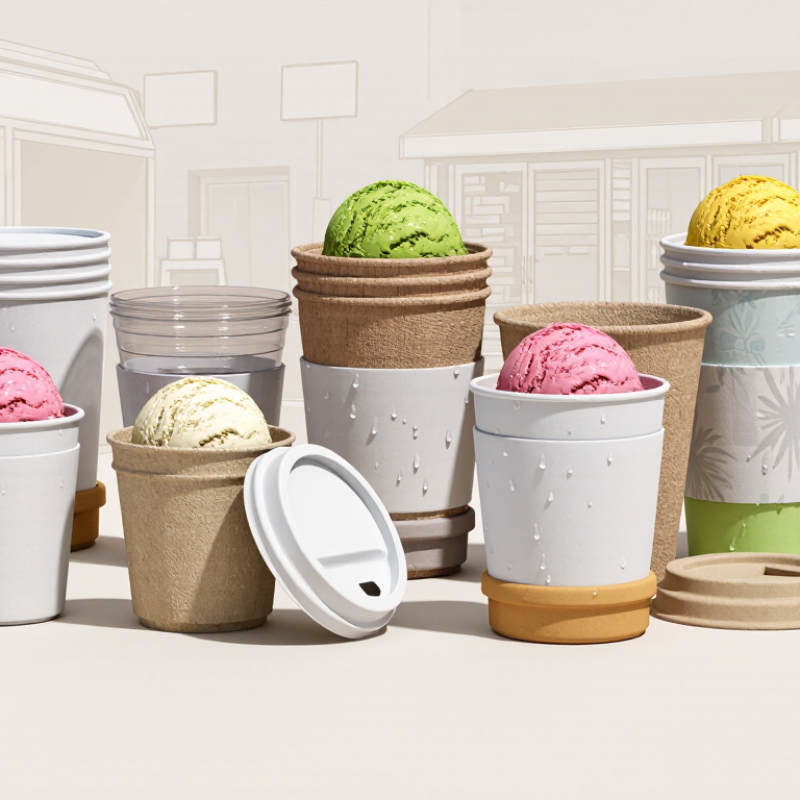
Disposable ice cream cups are classified by material, structure, shape, capacity, and intended service environment. This method helps global buyers compare products beyond appearance. In purchasing reviews, I check whether the cup survives frozen storage, filling pressure, stacking, and delivery movement. A low-cost cup can still create waste if its rim bends during serving.
Material is the clearest category. Common options include paperboard cups, polypropylene cups, clear plastic cups, molded fiber cups, and certified compostable cups. Paperboard suits printed takeaway packaging and feels comfortable in the hand. Polypropylene offers strong moisture resistance and works well for dense, frozen desserts. Clear cups improve product visibility. Molded fiber provides a different tactile experience, but its surface may soften when exposed to condensation. Compostable options require careful checking of local facilities and certification details. Compostable is not automatically suitable everywhere.
Structure creates another useful classification. Single-wall cups are lightweight and economical. Double-wall cups provide more insulation and reduce the need for an outer sleeve. Ripple-wall designs add grip and visual texture. Buyers can also classify cups by shape, such as straight-wall, tapered, square, or mini tasting cups. Capacity usually ranges from small sampling sizes to larger family portions. Lid compatibility matters too. A perfect cup with a poor-fitting lid is still a weak package. I would test filled samples for leakage, stacking stability, freezer performance, and print quality before placing a large order. Specifications can look convincing. Real handling may disagree.
| No. | Cup Type | Primary Material | Typical Capacity | Cup Structure | Common Lid Compatibility | Insulation Level | Typical Applications | Key Sustainability and Compliance Considerations |
|---|---|---|---|---|---|---|---|---|
| 1 | Single-Wall Paper Cup | Paperboard with a polyethylene or water-based barrier coating | 90–500 ml | One paperboard wall with a moisture-resistant inner lining | Flat, dome, or snap-on plastic lid | Low to moderate | Takeaway scoops, soft serve, tastings, and portion-controlled desserts | Paper content can support fiber recovery where suitable facilities exist; plastic coatings may affect recyclability. Local food-contact and packaging rules apply. |
| 2 | Double-Wall Paper Cup | Two layers of paperboard, usually with an inner moisture barrier | 120–500 ml | Two paper walls that create an insulating air layer | Flat or dome snap-on lid | Moderate to high | Premium takeaway service, delivery, and frozen desserts requiring improved hand comfort | Uses more fiber than a single-wall cup but can reduce the need for a separate sleeve. End-of-life performance depends on coatings and local collection systems. |
| 3 | PE-Coated Paper Ice Cream Cup | Paperboard lined with polyethylene | 90–750 ml | Rigid paperboard body with a heat-sealed moisture barrier | Paperboard, PET, or PP lid, depending on design | Low to moderate | Retail scoops, gelato portions, catering, and multipack dessert service | Good moisture and grease resistance; conventional PE lining is not the same as compostable lining and may require specialized recycling infrastructure. |
| 4 | Water-Based Coated Paper Cup | Paperboard with a water-based dispersion barrier | 90–500 ml | Paperboard body with a thin aqueous coating designed for moisture resistance | Flat or dome lid made from paperboard or plastic | Low to moderate | Cafés, ice cream parlors, events, and buyers seeking fiber-based packaging options | May be more compatible with paper recycling than conventional plastic-laminated stock, but actual recyclability depends on coating weight, cup design, and local mill capability. |
| 5 | PLA-Lined Paper Cup | Paperboard lined with polylactic acid, a bio-based polymer | 90–500 ml | Paperboard body with a PLA moisture barrier | PLA, PET, PP, or fiber-based lid, subject to fit and temperature requirements | Low to moderate | Cold desserts, events, and foodservice programs specifying bio-based materials | PLA is industrially compostable under suitable conditions; it generally does not compost in home systems and should not be described as universally biodegradable. |
| 6 | PP Plastic Ice Cream Cup | Polypropylene | 100–1,000 ml | Rigid, injection-molded or thermoformed plastic wall | Matching PP snap-on or peelable lid | Low | Takeaway servings, frozen yogurt, gelato, delivery, and retail portion packs | Lightweight and resistant to moisture and low temperatures. Recycling availability varies significantly by country and municipality. |
| 7 | PET or rPET Clear Cup | Polyethylene terephthalate; rPET versions include recycled PET content | 150–700 ml | Clear, rigid thermoformed or injection-molded body | Clear flat, dome, or hinged PET lid | Low | Layered desserts, visible toppings, parfaits, promotional servings, and chilled takeaway products | High clarity supports product visibility. PET recycling systems are established in many markets, but cup recycling depends on collection, sorting, sleeves, lids, and local acceptance. |
| 8 | Molded Fiber Cup | Bagasse, molded cellulose, or other plant-fiber pulp with a functional barrier | 100–500 ml | Pressed fiber wall with an inner coating or treatment for moisture resistance | Fiber, PLA, PET, or PP lid, depending on the product system | Moderate | Eco-positioned foodservice, festivals, catering, and single-serve frozen desserts | Compostability claims require the correct certification, coating, and processing conditions. Fiber cups can lose performance if exposed to melting ice cream for extended periods. |
| 9 | Foam Polystyrene Cup | Expanded polystyrene foam | 120–500 ml | Low-density closed-cell foam wall | Lightweight plastic flat or dome lid | High | Cold-chain takeaway service where legally permitted and where maximum thermal protection is required | Provides strong insulation but is restricted or prohibited for foodservice packaging in many jurisdictions. Buyers must verify destination-market legislation before ordering. |
| 10 | Aluminum Ice Cream Cup | Food-contact aluminum sheet or foil laminate | 100–1,000 ml | Rigid or semi-rigid metal container with a formed rim | Aluminum foil seal, peelable lid, or snap-on plastic lid | Low without an outer sleeve | Baked or frozen desserts, portion packs, catering, and products requiring strong barrier protection | Aluminum is widely recyclable where collection exists and retains material value; contamination, small format, and attached materials can reduce recovery rates. |
| Capacity ranges are indicative commercial ranges rather than universal standards. Final selection should be validated against filling temperature, storage conditions, lid fit, food-contact requirements, labeling rules, and end-of-life infrastructure in the destination market. | ||||||||
Cups are classified by material, structure, shape, capacity, and service environment. A straight-wall cup differs from a tapered tasting cup. Capacity may range from small samples to family portions.
Common materials include paperboard, coated paper, polypropylene, clear plastic, molded fiber, bagasse, PLA-lined paper, and aluminum. Each material handles cold, moisture, stacking, and transport differently. No material wins everywhere.
Single-wall cups are lightweight and usually economical. Double-wall cups provide better insulation and reduce the need for an outer sleeve. Ripple-wall designs improve grip. They can also add texture.
Polypropylene generally resists moisture, cracking, and low temperatures. Paperboard can perform well when its coating is suitable. Molded fiber may soften near melting ice cream. Test under real freezer conditions.
Fill samples and store them at minus 18 degrees Celsius. Check leakage after fifteen minutes. Inspect rims, lids, stacking stability, and print quality. Repeat testing with samples from separate production lots. One trial is not enough.
A poorly fitting lid can cause leakage during delivery. Check sealing pressure, opening convenience, and stacking stability. A strong cup cannot fix a weak lid. The details matter.
Compostable cups need suitable local composting facilities. They may not decompose in ordinary soil. Recycled content should have supporting records. Printed claims alone are not sufficient. Claims need proof.
Request food-contact declarations, migration test results, composition data, and production-lot traceability. Ask for current certificates, not old templates. Coating details also deserve review. Paper can be misleading.
Compare unit price, lids, freight, minimum order quantities, defect rates, and disposal fees. A cheaper cup may bend during serving and create more waste. Compostable packaging may cost more without local processing. The lowest quote is not always economical.
This guide presents the top ten Disposable Ice Cream Cup types for global buyers, explaining how they are classified by material, structure, capacity, shape, insulation, and intended use. It compares paper, plastic, compostable, insulated, ripple-wall, clear, cone-shaped, portion, dessert, and takeaway cup options, highlighting their advantages and limitations for serving performance, presentation, transport, and storage. Readers will also learn how different sizes and designs influence consumer convenience and product protection.
The article evaluates each option through a practical balance of durability, unit cost, customization potential, recycling or compostability, and overall environmental impact. It also outlines key considerations for international sourcing, including food-contact suitability, labeling, documentation, manufacturing consistency, packaging efficiency, quality control, and supplier reliability. By applying these criteria, buyers can select cup solutions that match their product requirements, budget, sustainability goals, and target markets while reducing procurement risks and improving the customer experience.

 Charmlite Cup